What is local SEO, and why does it matter for your business?
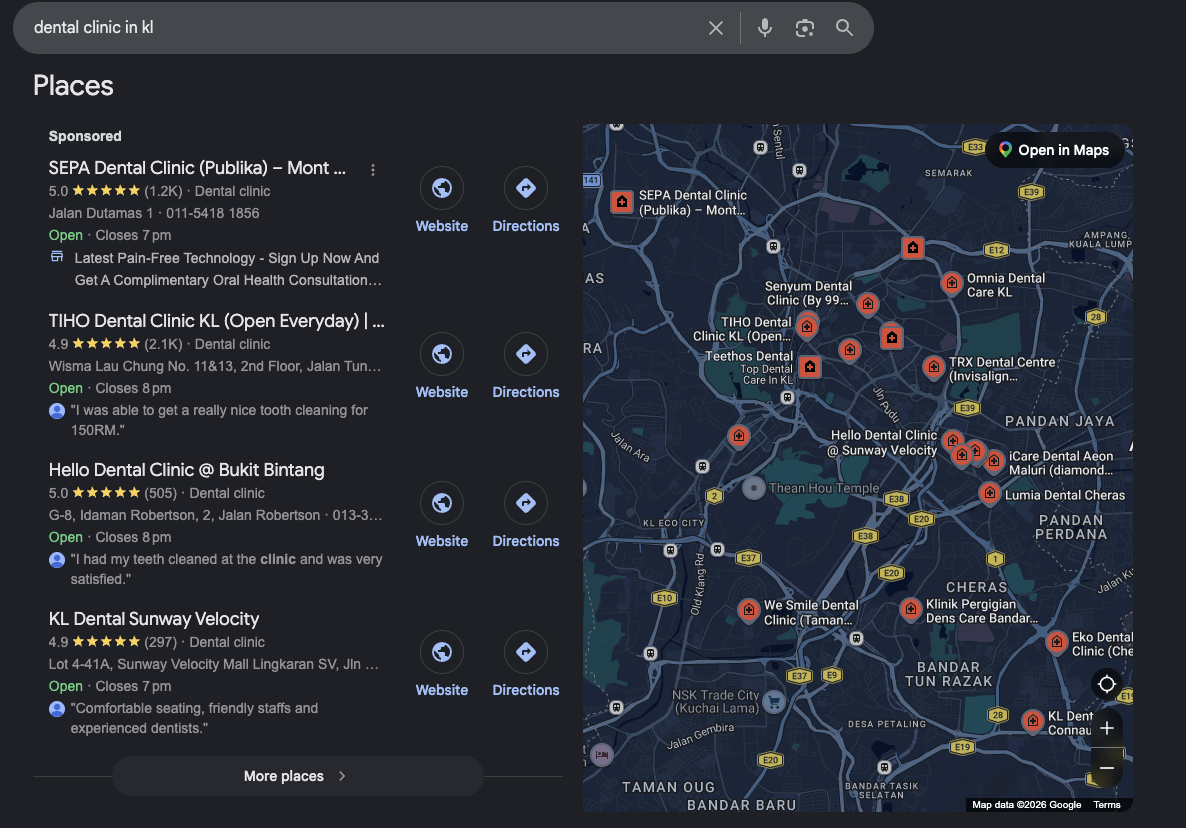
Picture someone standing in central KL on a Tuesday afternoon with a toothache. They pull out their phone and type "dental clinic in KL." Within a second, Google shows a map with a handful of pins, and directly underneath it, a block called the local pack, sitting above almost every normal blue link.
That local pack shows:
- A map with pinned locations
- Three business listings, no more
- A star rating and review count for each
- Opening hours, and whether it is open right now
- A Directions button, one tap to get moving
Whichever three clinics appear there get the call in the next five minutes, the three Google decided were the closest and most trustworthy match for that exact search.
That is local SEO in one scene: making sure your business is one of those three, or at minimum visible in the local-flavoured organic results just beneath the pack. It is a different job from ranking a blog post for a broad national term, it is about winning a specific, time-sensitive moment for someone close enough to actually walk through your door.
This matters more than most business owners assume, because local searches carry different intent than general browsing. Someone searching "dental clinic in KL" has usually already decided they need a dentist, and wants somewhere reachable, open and reputable today, not a shortlist for next month. If your business is invisible in that local pack, you are not losing a browsing visitor who might return later, you are losing a customer who is about to become someone else's, often within minutes. That is the commercial weight behind "local SEO," and why we treat it as its own discipline rather than a footnote inside broader SEO services.
How is local SEO different from national or international SEO?
To understand local SEO properly, it helps to see where it splits from general SEO, since the two solve genuinely different problems despite sharing much of the same mechanics.
General SEO, the kind of work covered under our own SEO services, tries to answer one question: out of everything published online, which page is the most relevant, most authoritative answer to this search, for anyone, anywhere. Search "SEO Malaysia" from Bangsar or from a hotel room in London, and you will see largely the same results.
Now hold that against two almost identical phrases: "SEO company near me" and "SEO services near me." Run either from Petaling Jaya, then from Johor Bahru, and the results will be almost entirely different, even though the words barely changed. Google has recognised these as location-based searches, and is solving a second problem on top of relevance: which business is actually close enough, and locally reputable enough, to serve this person right now.
| What Google weighs | National / general SEO | Local SEO |
|---|---|---|
| Main ranking factor | Content relevance and topical authority | Relevance, plus proximity to the person searching |
| Google Business Profile | Not a factor | One of the strongest signals |
| Business details (NAP) | Rarely matters | Consistency across the web is a trust signal |
| Reviews | Indirect at best | A direct, heavily weighted ranking signal |
| Where you can appear | The main organic results list | The map pack and the organic list, at the same time |
That last row is worth sitting with, because the map pack and the organic results underneath it run on related but separate ranking processes. A single business, done properly, can rank well in both at once, for the same search, effectively doubling visibility for the same work. It is exactly why we approach local SEO and general SEO as one coordinated strategy: the technical health and content quality your SEO services work builds still matters here, layered underneath proximity and trust signals general SEO never touches.
Why search intent is different from city to city in Malaysia
A generic "our locations" page, listing three or four addresses at the bottom of an About page, rarely performs the way business owners expect, because local intent in Malaysia does not behave uniformly from one city to the next.
Two things shift between cities:
- Language. Someone in Klang might search "klinik pergigian dekat sini," while someone in KL searches "dental clinic near KLCC" for the same need. Content that only exists in one language is structurally invisible to a real share of that demand.
- KL leans on landmarks like Bangsar, Mont Kiara or KLCC
- Penang leans on Gurney Drive or George Town
- Johor Bahru leans on Taman Molek or near KSL City
- Ipoh, Kuching and Kota Kinabalu each draw on an entirely different local map again
Google reads these mentions as genuine location signals. A page that only ever says "Kuala Lumpur" in generic terms gives Google far less to work with than a competitor whose content actually speaks the way locals search.
The practical fix: a business with more than one branch needs a dedicated Google Business Profile and a genuinely unique page for each location, not one shared page with addresses pasted underneath it, each page describing the actual neighbourhood it serves. A single-location business should apply the same idea at a smaller scale, described the way people in your own neighbourhood actually search.
The tools that tell you whether your local SEO is actually working
Two free tools, both directly from Google, cover almost everything you need to track here.
| Tool | What it actually shows you | What to check first |
|---|---|---|
| Google Business Profile (Performance) | How people found your listing: direct searches for your name versus discovery searches for a category or service, plus calls, direction requests, website clicks and photo views | Discovery search growth. That is a new customer finding you without knowing your name yet, which is exactly what local SEO is meant to produce |
| Google Search Console | The exact queries bringing impressions and clicks to your site, including location and "near me" style searches, and whether your location pages are properly indexed | Filter the Queries report for your city or area name and see whether, and where, you show up |
If Google Business Profile shows steady direct searches but flat discovery searches, your existing customers can find you fine, but local SEO is not bringing in new ones, look at profile completeness, reviews and citations next. If Search Console shows almost no impressions for your city name even though your profile looks healthy, that points to a content gap on your actual website. Used together, these two tools consistently point you toward the next fix.
The practical ways to actually improve your local SEO
Once you know what to track, the actual improvement work comes down to a small number of habits, done properly and maintained consistently over time.
- Fill out your Google Business Profile completely, and keep it active. Set the correct primary category, write a real, specific description of what you do, upload current real photos, keep opening hours accurate including public holidays, and post updates every so often rather than setting it up once and forgetting it.
- Keep your NAP identical everywhere. Your Name, Address and Phone number need to match exactly, character for character, across your website, Google Business Profile, Facebook page and every directory. "012-345 6789" and "+6012-3456789" read as conflicting details to Google, even though a person sees no difference. Worth doing once a year: search your own business name and check every listing that comes up actually matches.
- Build a genuine review strategy. Ask for a review right after a genuinely good interaction, with a direct link rather than an unprompted request, and respond to every review, good and bad. Never buy or incentivise fake reviews, Google actively looks for that pattern, and getting caught can cost you the entire listing.
- Earn local citations and local links. Get listed properly on relevant Malaysian directories and industry association listings, and earn genuine mentions or links from local publications rather than low-quality, mass-submitted directories. Every citation is evidence to Google that your business is an established, verifiable part of that area.
We saw this play out directly with Sri KDU Schools, a client running three campuses across Kota Damansara, Subang Jaya and Klang. Before we started, the school group had strong brand recognition but was close to invisible for the non-branded searches prospective parents were typing, with each campus competing under one shared, generic identity. Building a dedicated local SEO presence for each campus individually was a meaningful part of a 375% increase in Top 10 keyword rankings across the group.
How to find the local keywords people are actually searching for
Good local SEO depends on targeting the words real people actually type, not the words you assume they type. Three free methods cover almost everything:
- Google Keyword Planner. Free inside a Google Ads account, no ads required. Set the location to Malaysia or a specific city, and it shows search volume plus related suggestions. Look for variants with a city, an area name, or "near me."
- Google's own autocomplete. Open a private window, type your core service, and read what Google suggests before you finish typing. Add a city name partway through and watch the suggestions change.
- The People Also Ask box. Search your main service and read the "People Also Ask" questions. These are genuine follow-up questions, often local in nature, and the strongest ones can become FAQ content on your own site.
None of this is one setting to switch on and forget. It is a handful of habits, kept up consistently:
- An active, fully completed Google Business Profile
- Consistent NAP everywhere
- A genuine review strategy
- Location-specific content for every branch
- Keywords pulled from what people actually search, not what you assume
Get those right, and a business with a genuinely good product or service finally shows up in the moment that matters most, right when someone nearby is deciding who to call.