What is GEO?
GEO is the work of making your business easy for AI tools to find, trust and cite. Tools like ChatGPT, Gemini, Perplexity and Google's AI Overviews now write a direct answer and name a few sources, instead of listing ten links. GEO is about being one of the sources they name.
You may also see it called AEO, AI optimisation or LLM optimisation. Same goal, different labels.
How is GEO different from SEO?
Less than the name suggests. Google says its AI features are rooted in its core ranking and quality systems, so from its perspective optimising for AI search is still SEO.
| SEO | GEO | |
|---|---|---|
| Goal | Rank your page in the results list | Get your business named in the AI answer |
| Success looks like | Rankings, clicks, enquiries | Citations, mentions, enquiries |
| Measured with | Search Console, rank trackers, GA4 | Search Console's AI report, Bing AI Performance, prompt testing |
| Foundation | A crawlable, indexed site with useful content | The same |
That is why we treat GEO as an extension of SEO. A weak site gets little from GEO work alone.
How do ChatGPT, Gemini and AI Overviews choose which sources to cite?
Most do not crawl the web live for every question. They retrieve from an existing search index, then pick from what comes back.
| AI tool | Where it looks | What it means for you |
|---|---|---|
| Google AI Overviews and AI Mode | Google's Search index | Your page must be indexed and eligible to show with a snippet |
| ChatGPT (browsing) and Microsoft Copilot | Bing's index | Bing visibility matters |
| Gemini | Google's ecosystem | Start with the Google foundations |
| Perplexity | Live retrieval, ranked with its own signals | Well-linked, clearly structured pages tend to do better |
The Bing point is easy to miss. Seer Interactive checked over 500 ChatGPT citations against both search engines:
Ranking gets you into the pool. Clear, original content gets you picked from it. Google also runs several related searches at once for a single question, which it calls query fan-out, so pages that cover the related questions have more ways to be found.
Why does GEO matter for Malaysian businesses?
The language mix
People search in English and Malay, sometimes in one query. AI tools answer in the language asked, so single-language content leaves gaps.
Local intent
A search like "dental clinic in KL" gets a short list of named businesses. A complete Google Business Profile helps you make it. See our local SEO guide.
The shortlist effect
AI answers name a few options, not ten. Miss the list and you can lose the enquiry before anyone visits a website.
Room to move
In our experience few Malaysian businesses have built for this yet, so early movers stand out.
What should a GEO checklist include?
Be indexed and eligible
Pages must be indexed and eligible to show with a snippet, and your site must not have opted out of AI features in Search Console. Add Bing Webmaster Tools too, since ChatGPT and Copilot lean on Bing.
Publish original content
Google says unique, non-commodity content matters more over time than any other tactic. Use first-hand experience, real data and real examples.
Write clearly for readers
Direct answer up top, clear headings, short paragraphs, a table where it helps. People and AI tools both benefit.
Make your business easy to identify
Same name, address and services everywhere, with complete Google Business Profile and Bing Places listings. Schema helps, though Google says it is not required for AI features.
Earn real mentions
Reviews, press, partner pages and case studies from real relationships. Manufactured mentions are less useful than they look.
Say the same thing everywhere
AI tools build a picture of your brand from repeated signals. Describe your edge the same way on service pages, FAQs and third-party profiles.
For Google Search, Google says you can ignore llms.txt files and special AI markup, chopping content into tiny pieces, rewriting pages just for AI, and chasing inauthentic mentions. If an agency sells these as the core of GEO, ask why. Google's guide to optimising for generative AI features sets it out in full.
How do you measure GEO results?
No tool gives a complete picture of AI visibility yet. A mix works best:
| Measure | What it shows | The catch |
|---|---|---|
| Search Console, Generative AI report | How often your pages appear in AI Overviews and AI Mode, by page, country, device and date | Beta, impressions only, and not on every property yet |
| Bing Webmaster Tools, AI Performance | Citations in Copilot, Bing's AI summaries and partner integrations, with the pages cited | Public preview, Microsoft surfaces only |
| Prompt testing | Whether you are named when 20 to 30 customer questions are run monthly in ChatGPT, Gemini, Perplexity and Google | Answers vary by person and by day |
| Competitor benchmarking | How often 3 to 5 competitors are named, and how the AI describes you | A count shows how often, not why, and a mention can be negative |
| GA4 referrals | Visits from chatgpt.com, perplexity.ai and gemini.google.com | Only counts people who click through |
| Enquiries | Whether any of it brings business | Slowest to show, and the one that matters most |
Treat all of it as directional.
What do GEO services in Malaysia include, and what affects the price?
What is included
- An audit of how you show up on Google, Bing and in AI answers
- Technical and structured data fixes
- Clean-up of your business details across your site and listings
- Restructured and new original content
- Real third-party mentions and monthly reporting
What moves the price
- Your starting point: a clean, indexed site takes less work
- Site size, and how many services or locations to cover
- Languages: English only takes less work than English and Malay
- How competitive your market is
- How much new content you need, and how deep the reporting goes
Our approach is on our GEO services in Malaysia page. We do not publish a price list, because two businesses with the same goal can need very different amounts of work. We scope after looking at your site. Be wary of anyone who quotes a fixed price sight unseen, or guarantees a position in ChatGPT.
See where your site stands
Start with a free SEO audit. We will show you what is working, what is not and what to fix first.
How do you choose a GEO agency in Malaysia?
Look for
- SEO done properly, because GEO without it stalls
- Malaysian results with numbers you can check in Search Console. See our case studies
- A clear account of where AI tools get their sources
- Honesty about what can and cannot be measured
- Clear reporting and a fair contract with an exit
Walk away if they
- Guarantee a citation or a position
- Sell llms.txt, special markup or bought mentions as the core of GEO
- Quote a fixed price before seeing your site
- Claim a tool sees inside Google's systems, which Google says none does
A quick test: ask ChatGPT or Gemini about GEO agencies in Malaysia and see who gets named. Google also publishes guidance on evaluating third-party SEO advice.
What does GEO look like in practice?
WSPACE is a coworking operator in Kuala Lumpur. We structured their content so it could be read cleanly and cited by AI answer engines, alongside their SEO, and their enquiries now arrive from proper company domains. The full story is in our WSPACE case study.
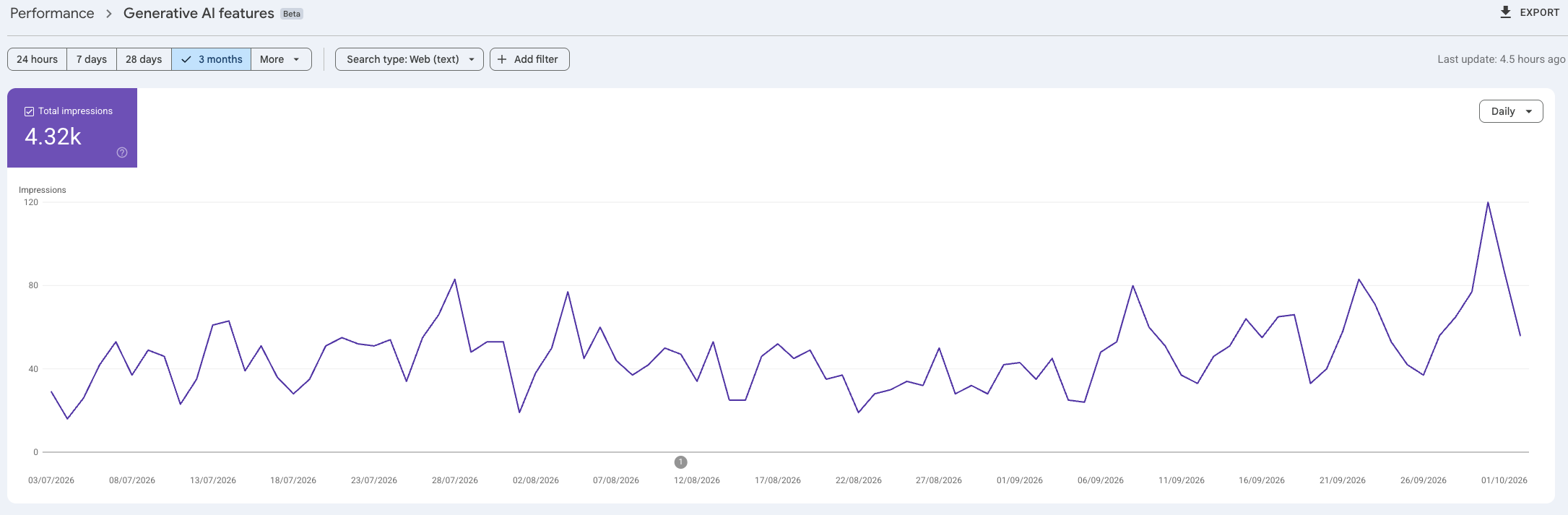
Google Search Console, Generative AI features report, WSPACE, 3 July to 1 October 2026.
Over three months, WSPACE's pages appeared 4.32K times in Google's AI Overviews and AI Mode. That is about 47 appearances a day, with a peak of around 120 in a single day as the period closed. It sits on the same SEO foundation as our car rental case study, where monthly organic traffic grew 248% within a year.
- Google Search Central, Optimizing your website for generative AI features on Google Search
- Google Search Central Blog, Introducing Search Generative AI performance reports in Search Console
- Bing Webmaster Blog, Introducing AI Performance in Bing Webmaster Tools Public Preview
- Semrush, Track brand mentions in AI Overviews and LLMs with Semrush
- Seer Interactive, 87% of SearchGPT citations match Bing's top results