Why a shared global domain breaks local SEO
This is worth explaining properly, because most business owners in this exact situation have no idea it is happening to them. When a local subsidiary's pages sit under a parent company's global domain, several things happen at once, and none of them help the local business.
- Keyword cannibalisation. If the global domain has pages targeting the same or similar terms across multiple country versions, Google has to decide which page to show for a search happening in this specific market. Rather than picking the best one, it often ends up splitting authority and relevance signals across all of them, which can suppress every version's ranking, including the one that should actually win for that market.
- Diluted crawl budget. Google allocates a limited amount of attention to crawling any given domain. A large global domain with pages across every market it operates in means the local country's pages are competing for crawl attention against every other country's pages too. Freshly updated local content can sit uncrawled for longer than it should.
- Authority pointing the wrong way. Backlinks, mentions and citations earned by local PR or partnerships tend to point to the domain people know, usually the global one, or get attributed to a generic global page instead of the specific local page that deserves the credit. Over time the global domain gets stronger while the part of the site that matters to this market stays exactly where it started.
- No room for local content ownership. Global domains are usually built to a corporate template that has to work across every market at once, which makes it very difficult to publish genuinely local content without going through layers of approval from a global team with different priorities.
Left alone, none of this fixes itself. It gets slowly worse as the global domain keeps growing and the local business keeps depending more heavily on paid channels just to stay visible in its own market.
How we diagnosed it
Before recommending anything as disruptive as a domain migration, we ran a full audit to confirm the problem was actually structural, not something smaller. That meant:
- Checking indexation and crawl behaviour for the client's specific market pages versus the rest of the global domain
- Reviewing Search Console data to see whether the client's pages and the parent domain's pages were both showing impressions for the same queries, a direct sign of cannibalisation
- Auditing the backlink profile to see where earned authority was actually landing
- Mapping every existing URL on the client's section of the site, since a migration is only as clean as the map behind it
This confirmed what we suspected: the client's local pages were structurally boxed in, and no amount of on-page optimisation was going to fix a problem that lived at the domain level.
Why migration, not a smaller fix
Domain migration is not a decision to make lightly. It is disruptive, it carries real risk if handled badly, and it is a genuinely difficult internal conversation for any business operating inside a larger group. We considered smaller interventions first, like restructuring the existing setup with better hreflang signals or pushing for a dedicated subfolder instead of a full domain. In this case, neither was realistic given how the parent company's platform was built, which meant a full migration to an independently owned domain was the only option that actually solved the underlying problem rather than working around it.
What we did
Once the client committed, the work broke down into three phases.
Migration and redirect mapping
We moved the site onto its own dedicated domain and built a full 301 redirect map covering every existing URL, so search engines were pointed cleanly from the old address to the new one instead of hitting dead ends. This is the step most likely to go wrong in a migration, since a single missed redirect can mean losing the ranking equity that page had built up.
Technical and tracking continuity
Structured data, canonical tags, the XML sitemap, robots.txt rules and every tracking and analytics property were rebuilt and verified on the new domain, tested before launch and monitored closely afterward. In the weeks following a migration we watch Search Console daily for crawl errors, unexpected drops in indexed pages, or redirect chains that need cleaning up. Most of the ranking damage that happens in migrations happens because nobody was watching closely enough in this window.
Independent content strategy
With the business finally free of the global template's constraints, we built out informational blog content specific to this market, the kind of content that simply was not possible to publish while every page had to be approved against a global corporate standard. This gave the new domain its own reasons to earn authority and rank for the searches that actually matter locally, rather than borrowing whatever authority trickled down from the parent domain.
The results
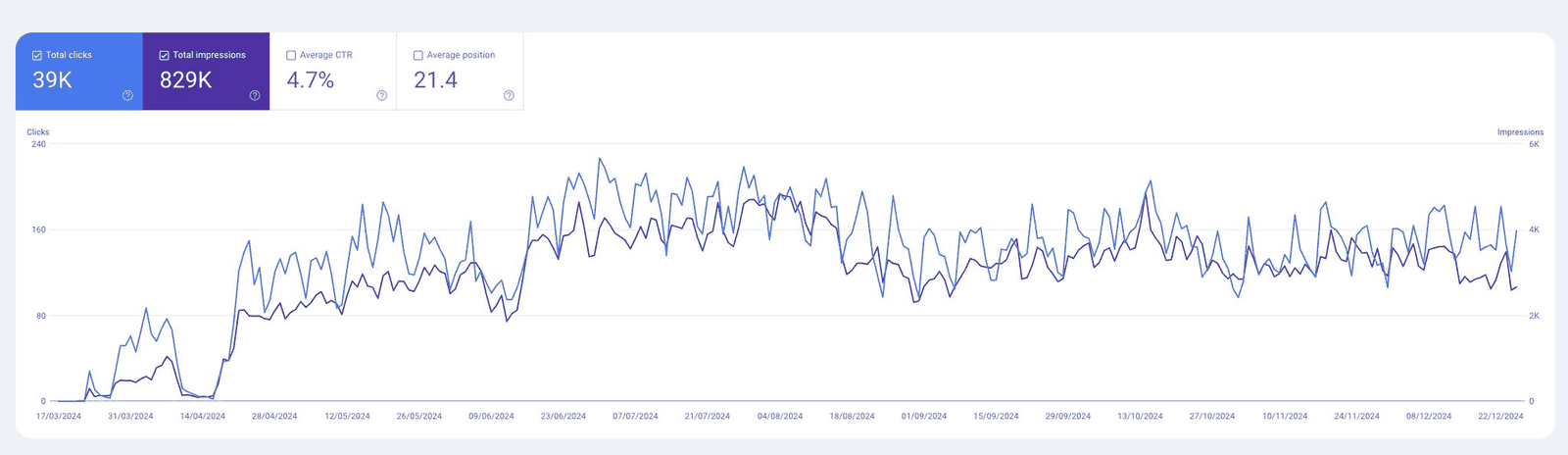
Actual Google Search Console data, 16 month view: 39K total clicks, 829K total impressions, 4.7% average CTR, 21.4 average position.
The growth held. It was not a short-term spike that faded once the migration novelty wore off, it was a sustained climb that kept compounding as the new domain built its own independent authority. Demand grew fast enough that the client faced supply shortages more than once, a rare problem that is actually a very good sign.